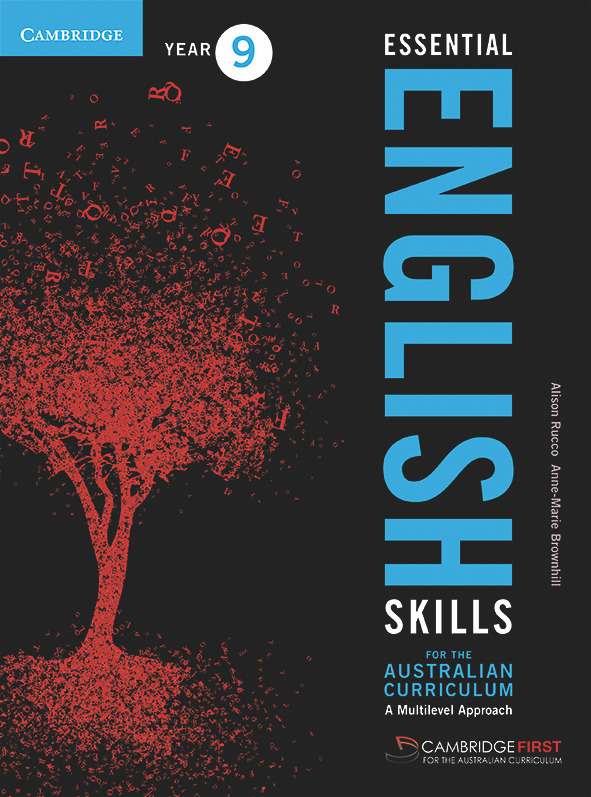
Essential English Skills Year 9 for the Australian Curriculum
To access your resources Log inor
create your Cambridge GO account
Activate your resources by entering the access code found in the front of your print textbook,
sealed pocket or supplied via email.

 Electronic Version
To view a sample chapter, please click on the file in blue.
PDF updated October 2014
Electronic Version
Preliminary pages [PDF 0.9Mb]
Part 1 Grammar, punctuation, spelling and vocabulary [PDF 2.8Mb]
Part 2 Reading and comprehension [PDF 4.5Mb]
Part 3 Writing and editing [PDF 1.7Mb]
You are entitled to download and store these PDFs. However they may not be transferred to another party, including other students, as electronic or print versions.
To use the enhanced PDF functions, such as note taking, you must download these PDFs to your computer and open them with Adobe Reader 9 or later.
The PDF Textbook is designed for full functionality using the latest version of Adobe Reader. The markup function is available in selected PDF readers for the iPad and other devices using iOS. Check your PDF reader specifications. At the time of publication, Adobe Reader, Good Reader and PDF Expert were viable options.
Note that some PDF file names may comprise the ISBN and chapter number.
You must have Adobe Reader installed to view the PDF files.

To view a sample chapter, please click on the file in blue.
PDF updated October 2014
Electronic Version
Preliminary pages [PDF 0.9Mb]
Part 1 Grammar, punctuation, spelling and vocabulary [PDF 2.8Mb]
Part 2 Reading and comprehension [PDF 4.5Mb]
Part 3 Writing and editing [PDF 1.7Mb]
You are entitled to download and store these PDFs. However they may not be transferred to another party, including other students, as electronic or print versions.
To use the enhanced PDF functions, such as note taking, you must download these PDFs to your computer and open them with Adobe Reader 9 or later.
The PDF Textbook is designed for full functionality using the latest version of Adobe Reader. The markup function is available in selected PDF readers for the iPad and other devices using iOS. Check your PDF reader specifications. At the time of publication, Adobe Reader, Good Reader and PDF Expert were viable options.
Note that some PDF file names may comprise the ISBN and chapter number.
| You must have Adobe Reader installed to view the PDF files. |
|

